American Foulbrood (AFB)
Paenibacillus larvae — a spore-forming bacterium
Signs to look for
- Spotty, patchy brood pattern — capped cells mixed with empty ones, scattered across the frame rather than the tight pattern of a healthy hive
- Sunken, dark, perforated cappings — the wax cap dips inwards and may have small holes punched through it
- Larvae change colour from pearly white to coffee-brown, then to a sticky, glue-like mass
- Rope test (the classic identifier): when you push a matchstick or twig into an affected cell and slowly pull it out, the contents draw out in a long sticky thread — typically 2–3 cm or more
- Smell: a distinctive sour, foul odour (this is where "foulbrood" gets its name)
- Hard scale: in older infections, dried larval remains form a hard, black, scale-like deposit on the lower cell wall that cannot easily be removed
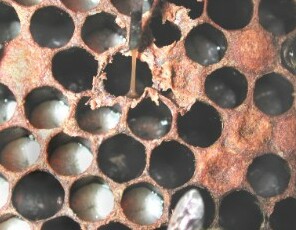
Photo: Pollinator / CC BY-SA 3.0 / via Wikimedia Commons
What to do next
- Stop opening hives in the apiary. Robbing risk goes up the moment a hive is opened.
- Call your bee inspector using the numbers at the top of this page.
- Do not move anything from the suspect apiary — bees, frames, supers, hive tools, smoker, suits. AFB spores cling to all of them.
- Wait for the inspector to attend. They will confirm with a field test or lab sample.
- If confirmed: the inspector will direct the course of action. For AFB in the UK and Ireland this almost always means destroying affected colonies and equipment by burning, under supervision. This is heart-breaking but it is how the bee community stops AFB at the source. Compensation arrangements vary by jurisdiction.
Why it matters
AFB is the most serious brood disease honeybees face. The bacterial spores are extremely resistant — they survive heat, cold, time and most disinfectants. A single neglected case can seed an outbreak across a region. UK and Irish bee inspectors actively track AFB and have legal powers to enter, inspect and destroy. Early reporting protects your apiary and your neighbours' apiaries.
Sources & further reading
- NBU — Foulbrood Disease of Honeybees and Other Common Brood Disorders (2017). nationalbeeunit.com
- DAERA NI — Bee diseases and notifiable disease guidance. daera-ni.gov.uk
- The Bee Diseases and Pests Control (Northern Ireland) Order 2007 — legislation.gov.uk
- Genersch, E. (2010) "American Foulbrood in honeybees and its causative agent, Paenibacillus larvae." Journal of Invertebrate Pathology, 103, S10–S19.
Last reviewed: 14 May 2026
European Foulbrood (EFB)
Melissococcus plutonius — a bacterium
Signs to look for
- Uncapped larvae that look "wrong": twisted, slumped to one side, or melted into the bottom of the cell — instead of plump, white and curled in a tidy "C" shape
- Colour change: healthy larvae are pearly white. EFB-affected larvae go yellowish, then brown
- Patchy brood pattern as workers remove dying larvae, similar to AFB but with mostly uncapped cells affected, not capped ones
- Sour smell in some cases — less marked than AFB
- Rope test: the larval contents may stretch slightly when pulled, but typically only 1–1.5 cm — not the long thread of AFB
- Scale (rare, in late stage): dried larval remains may form a rubbery scale on the cell wall, but unlike AFB it can usually be picked out
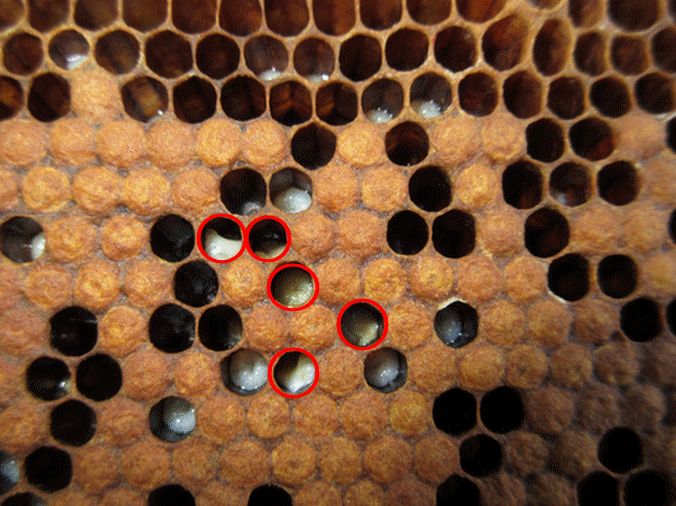
Photo: Výzkumný ústav včelařský s.r.o. (Czech Beekeeping Research Institute) / CC BY-SA 4.0 / via Wikimedia Commons
What to do next
- Call your bee inspector using the numbers at the top of this page.
- Stop moving colonies or equipment until the inspector has been.
- Wait for the inspector to attend — they will confirm with a field test (lateral flow) or send a sample to the lab.
- If confirmed: EFB can sometimes be treated with the "shook swarm" technique — shaking bees onto fresh foundation and destroying the old comb. In severe cases, the colony may be destroyed. The inspector directs the course of action. Some jurisdictions can prescribe oxytetracycline as a treatment — this is a prescription-only veterinary medicine and must be administered under direction.
Why it matters
EFB is widespread in some UK regions and can wipe out colonies if not addressed. The good news: with early detection and inspector-directed treatment, many colonies recover. The bad news: stress (poor forage, dampness, varroa pressure, queen issues) makes colonies much more vulnerable to EFB, so an outbreak is often a sign that something else is wrong in the apiary.
Sources & further reading
- NBU — Foulbrood Disease of Honeybees and Other Common Brood Disorders (2017). nationalbeeunit.com
- DAERA NI — Bee diseases guidance. daera-ni.gov.uk
- The Bee Diseases and Pests Control (Northern Ireland) Order 2007 — legislation.gov.uk
- Forsgren, E. (2010) "European foulbrood in honey bees." Journal of Invertebrate Pathology, 103, S5–S9.
Last reviewed: 14 May 2026
Chalkbrood
Ascosphaera apis — a fungus
Signs to look for
- White or grey "mummies" in cells, on the floor, or at the hive entrance — these are dead larvae that look like small pieces of chalk
- Spotty brood pattern where workers have removed mummified larvae
- Mummies on the landing board are often the first sign — bees remove them and drop them outside
- Older mummies turn dark as the fungus produces spores
- No foul smell — chalkbrood is dry and chalky, not sticky or stinking
Sourced via a UK beekeeping contact, with permission.
What to do next
- You do not need to call a bee inspector for chalkbrood — it is not notifiable.
- Improve hive conditions: chalkbrood thrives in cool, damp colonies. Make sure the hive has good ventilation, faces the sun where possible, and isn't sitting in a damp dip.
- Strengthen the colony: a strong colony will usually clear chalkbrood on its own once conditions improve. If the colony is weak, consider uniting it with a stronger one.
- Consider re-queening: susceptibility to chalkbrood is partly genetic. If the colony keeps showing chalkbrood season after season, the queen's line may be predisposed.
- Replace old, dark brood comb over a couple of seasons — spores accumulate in old wax.
Why it matters
Chalkbrood rarely kills a colony but it weakens it, reduces the worker population, and predisposes the hive to other problems. It tends to appear in spring when colonies are still small and the weather is changeable. Most beekeepers will see chalkbrood occasionally — it is part of beekeeping in cool, damp climates like the UK and Ireland. Persistent chalkbrood is a sign to review the apiary site and the queen.
Sources & further reading
- NBU — Common Brood Diseases of Honeybees (2017) — section on chalkbrood. nationalbeeunit.com
- Aronstein, K. A. & Murray, K. D. (2010) "Chalkbrood disease in honey bees." Journal of Invertebrate Pathology, 103, S20–S29.
- BBKA — Apiary Management Practical Guidance — chalkbrood management. bbka.org.uk
Last reviewed: 14 May 2026
Sacbrood
Sacbrood virus (SBV) — an iflavirus
Signs to look for
- Larvae fail to pupate and die just before or just after the cell is capped
- Cappings are discoloured, sunken and may be perforated — similar to AFB at a glance, which is one reason inspection by an experienced eye is important
- The "sac" sign (definitive): when you carefully lift an affected larva out with tweezers, it comes out intact in a fluid-filled sac — like a tiny water balloon — with the head curled towards the centre
- Larvae are pale yellow then darken to brown, eventually drying out
- Dried "Chinese slipper" remains: the dried scale has a distinctive curled, gondola-like shape with the head end turned upwards — easy to remove from the cell
- No foul smell.
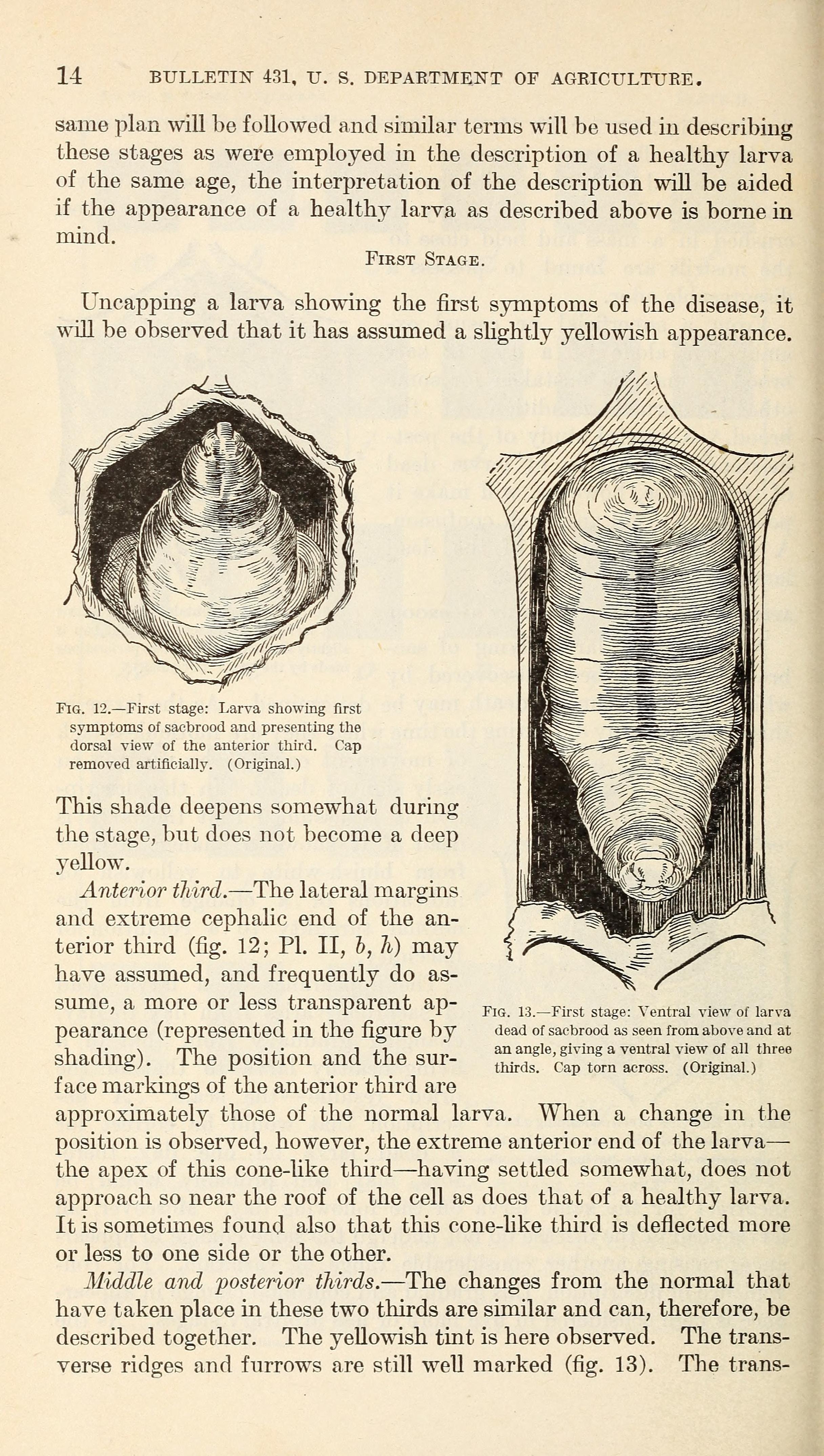
Source: G.F. White (1917), Sacbrood, U.S. Department of Agriculture, Bureau of Entomology, Bulletin No. 431 — Public Domain. Via Wikimedia Commons.
What to do next
- You do not need to call a bee inspector for sacbrood — it is not notifiable.
- Most cases clear on their own as the colony grows and replaces older bees. Strong colonies handle sacbrood well.
- Consider re-queening if sacbrood is severe or persistent — some queen lines are more susceptible.
- Watch for secondary issues: sacbrood is often linked to high varroa loads (varroa transmits viruses). Check your varroa count and treat if needed.
- If you are unsure whether what you are seeing is sacbrood or AFB, treat it as the worse case — call your bee inspector. The visible signs can overlap and the rope test is the easiest way to tell them apart.
Why it matters
Sacbrood is common, usually mild, and rarely fatal to a colony on its own. The reason to know it is twofold: first, so you can recognise it and not panic; second, so you can rule out AFB and EFB at the same time. The "Chinese slipper" dried-scale appearance is one of the few unambiguous identifiers in brood disease and is worth committing to memory.
Sources & further reading
- NBU — Common Brood Diseases of Honeybees (2017) — section on sacbrood. nationalbeeunit.com
- Bailey, L. (1969) "The multiplication and spread of sacbrood virus of bees." Annals of Applied Biology, 63, 483–491. (Foundational paper.)
- Genersch, E. & Aubert, M. (2010) "Emerging and re-emerging viruses of the honey bee (Apis mellifera L.)." Veterinary Research, 41, 54.
- BBKA — Apiary Management Practical Guidance — viral brood diseases. bbka.org.uk
Last reviewed: 14 May 2026
About this guide
What it is: a plain-English summary of the four brood diseases UK and Irish beekeepers most often need to recognise. We have written it so a beginner can use it at the kitchen table after an inspection.
What it is not: a substitute for inspection by a qualified bee inspector or for veterinary advice. Bee diseases can look similar to one another, especially in their early stages, and confirmation often requires a field test (lateral flow) or laboratory examination of samples. If you have any doubt about what you are seeing, contact your bee inspector before doing anything else.
Sources: All descriptions are drawn from official UK and Irish government bee-health publications (DAERA, the National Bee Unit, SASA, DAFM) and from peer-reviewed scientific literature. Each disease section lists its sources. The guide is reviewed at least every 12 months.
Photos: We use photographs released under Creative Commons or in the public domain, with full attribution beneath each photo and a complete source audit. The American Foulbrood and European Foulbrood images come from Wikimedia Commons under CC BY-SA. The Sacbrood image is from G.F. White's original 1917 USDA bulletin (public domain), the founding scientific paper on the disease. The Chalkbrood photo is being sourced separately and will be added shortly.
Maintained by: Apiary Records Ltd (NI739315), Northern Ireland. Got a correction, a citation we have missed, or a photo we can use? Email hello@beehappyhoney.uk.